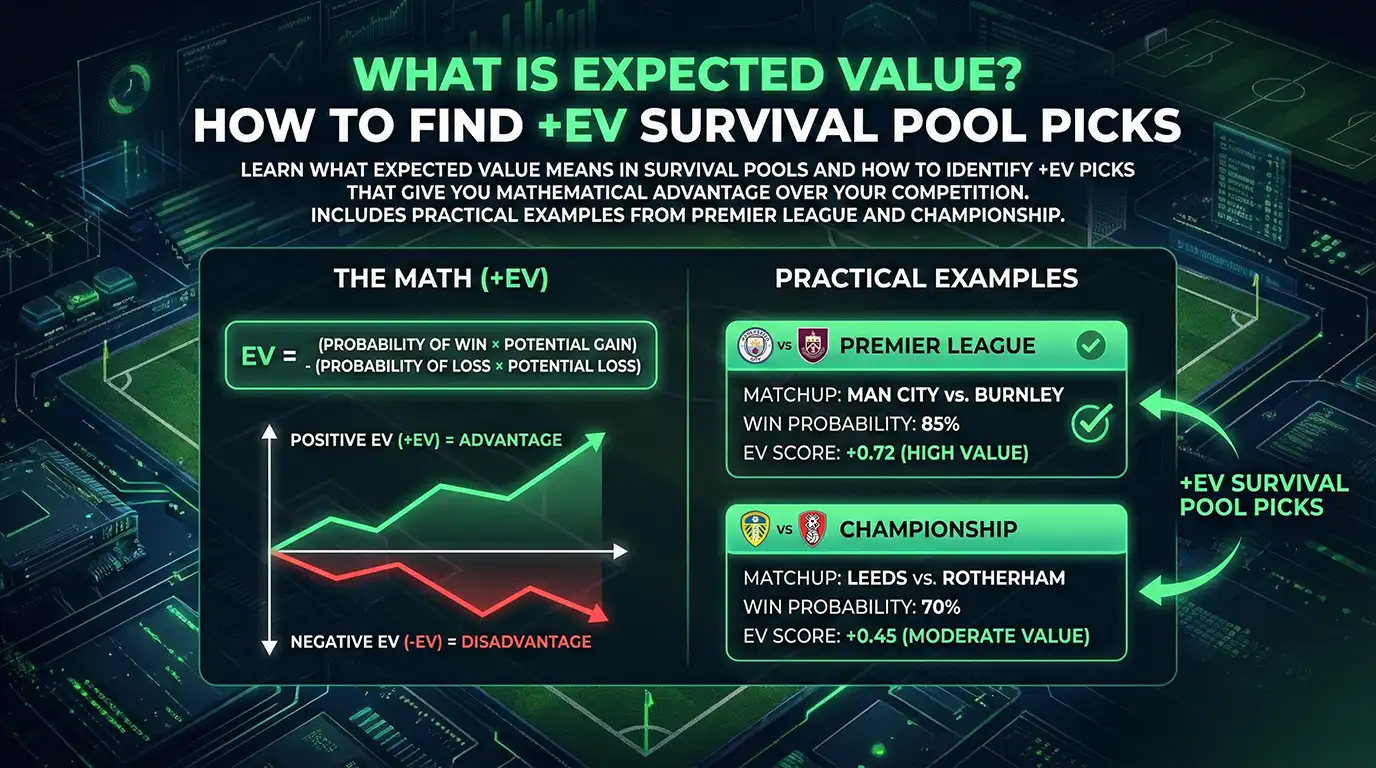
What Is Expected Value? How to Find +EV Survival Pool Picks
Expected value is one of the most powerful concepts in survival pool analytics, yet it's widely misunderstood by casual players. Simply picking the team with the highest win probability isn't enough—you need to understand which picks offer positive expected value (+EV) to maximise your chances of surviving long-term.
This guide explains expected value in the context of Last Man Standing pools, shows you how to identify +EV picks using data, and demonstrates why the favourites aren't always the optimal choice for your survival strategy.
Key Takeaway
Expected value combines win probability with crowd selection to identify picks that offer mathematical advantage over the average player. A +EV pick increases your expected survival rate relative to your competition.
Understanding Expected Value in Survival Pools
Expected value (EV) is a mathematical concept that measures the average outcome of a decision over many iterations. In survival pools, EV represents the relative advantage a pick gives you compared to your opponents based on two factors:
- Win probability: How likely the team is to win their fixture
- Crowd selection: What percentage of players have also picked this team
A pick has positive expected value (+EV) when it offers better survival odds than what the average player selected. Conversely, negative expected value (-EV) means you're taking on more risk than your competitors for equivalent or worse potential outcomes.
The EV Formula
A simplified way to think about EV in survival pools:
EV = (Your Win Probability) - (Average Player's Win Probability)
When EV > 0, you have a mathematical edge over the field.
Win Probability vs Expected Value: Critical Difference
Many players mistakenly believe that picking the team with the highest win probability is always optimal. This is false because survival pools are relative competitions, not absolute ones.
Consider this scenario:
Gameweek 15 Example
Manchester City vs Southampton
- Win probability: 85%
- Crowd selection: 60%
- Avg opponent survives: 51%
Arsenal vs Wolves
- Win probability: 72%
- Crowd selection: 25%
- Avg opponent survives: 47%
Result: Arsenal is +EV despite lower win probability because your survival advantage (25%) is greater than Man City's (15%) relative to opponent elimination rates.
The highest win probability team often attracts the most selections, diluting your competitive advantage. Sometimes a slightly weaker team with far fewer selections offers better expected value.
How to Calculate Expected Value for Survival Picks
Finding +EV picks requires analysing both team strength metrics and market sentiment. Here's the framework:
Step 1: Assess Win Probability
Evaluate each fixture using data-driven models:
- Market prices: Starting prices from bookmakers (reflective of true probability)
- Statistical models: xG (expected goals) differentials, recent form, squad value
- Fixture difficulty: Home/away splits, opponent quality, injuries/suspensions
Stat Pull-Out
Top-six Premier League teams at home against bottom-half opponents typically win 75-85% of the time. Mid-table teams at home against relegation candidates win 60-70% of the time.
Step 2: Estimate Crowd Selection
Understand which teams will attract the most picks:
- Public perception: Big clubs (Liverpool, Man City, Arsenal) draw disproportionate selections
- Recent results: Players chase teams coming off big wins
- Fixture appearance: "Obvious" matchups (e.g., Man City vs Luton) attract 50%+ of pools
- Team availability: Popular picks already used by players are unavailable
Step 3: Identify +EV Opportunities
Positive EV situations typically occur when:
- Underrated favourites: Strong teams that the public overlooks
- Star power unavailable: Elite teams already used by most players, leaving second-tier options
- Championship value: Quality Championship sides facing weakened opposition
- Asymmetric information: Injuries or lineups casual players miss
Practical Examples of +EV Picks
Example 1: Underrated Favourite
Gameweek Scenario
Newcastle (5th) vs Everton (17th) at St James' Park
- Data: Newcastle win probability: 68%
- Market: Most players flock to Man City (85% win prob) and Arsenal (78% win prob)
- Crowd: Only 15% select Newcastle
- Verdict: +EV pick because Newcastle offers strong win probability with significantly less crowd exposure than the elite options
Example 2: Championship Opportunity
Gameweek Scenario
Leicester City (Championship) vs QPR (bottom half)
- Data: Leicester win probability: 65%
- Market: Casual players rarely consider Championship fixtures
- Crowd: Only 8% of pool selections
- Verdict: Strong +EV opportunity—Leicester's quality is significantly above Championship average, yet public perception ignores them
Example 3: Differentiation Play
Late-Season Gameweek
Aston Villa vs Bournemouth
- Context: Man City, Liverpool, Arsenal already used by 80% of remaining players
- Data: Villa win probability: 62%
- Crowd: 30% select Villa (higher than usual but still far from saturated)
- Verdict: +EV relative to other available options; elite teams unavailable makes Villa attractive despite moderate probability
When to Ignore EV: Strategic Considerations
Expected value isn't the only factor in survival pool strategy. There are valid reasons to make mathematically suboptimal picks:
- Squad management: Saving elite teams for tougher gameweeks ahead
- Tournament position: Taking unnecessary risks when you're ahead or desperate when behind
- Scheduling conflicts: Future fixture congestion limiting team availability
- Late-season context: Motivation issues for teams with nothing to play for
Warning
Late-season motivation is difficult to quantify analytically. Teams safe from relegation but out of European contention may underperform win probability models. Adjust your EV calculations accordingly in April and May.
Building a Long-Term EV Strategy
Sustainable survival pool success requires thinking beyond individual gameweeks. Consider how EV decisions compound across the season:
Early Season (Gameweeks 1-10)
Prioritise accumulating +EV edges while popular teams remain available. This is when differentiation is easiest because the full squad inventory is untouched.
Mid-Season (Gameweeks 11-30)
EV opportunities become scarcer as elite teams get depleted. Focus on identifying underrated favourites and exploiting market overreactions to recent form.
Late Season (Gameweeks 31-38)
Motivation and scheduling dominate EV calculations. Cup runs, European competitions, and relegation battles create asymmetric information casual players miss.
Pro Tip
Track which elite teams your remaining competitors have available. In small pools, if your opponents have burned Man City but you haven't, Man City becomes extremely +EV even with high crowd selection—they literally cannot pick your team.
Tools for Finding +EV Picks
Effective EV analysis requires accurate data on both win probabilities and crowd selection:
- Opta/Stats Perform: Professional xG models and win probability forecasts
- Pool tracking platforms: Real-time crowd selection data from major survival pool platforms
- Injury news aggregators: squad status updates before they're priced into markets
- Fixture difficulty ratings: analytical tools that assess schedule strength beyond table position
Frequently Asked Questions
What is expected value in survival pools?
Expected value measures the relative advantage a pick gives you compared to your competitors. It combines win probability with crowd selection to identify picks that offer mathematical edge over the average player. A +EV pick increases your chances of surviving longer than your competition.
How do you calculate EV for survival pool picks?
EV calculation involves comparing your win probability against the average win probability of other players' picks. While the full formula is complex, a simplified approach is: EV = (Your Win Probability) - (Average Player's Win Probability). Positive EV means you have an advantage over the field.
Should I always pick the highest win probability team?
No. Survival pools are relative competitions, not absolute ones. Sometimes a slightly lower win probability team with far fewer crowd selections offers better expected value than the favourite everyone else is picking. Differentiation from the crowd is essential for long-term survival.
What makes a survival pool pick +EV?
A pick is +EV when it offers better survival odds than what the average competitor selected. This typically happens with underrated favourites that casual players overlook, or when elite teams are unavailable due to previous selections, creating value with second-tier options.
Does EV matter more than win probability?
EV matters more than raw win probability because survival pools are zero-sum games against other players. A 90% win probability pick that 70% of players choose is often worse than a 75% win probability pick that only 10% choose. You're trying to outlast opponents, not maximise absolute win probability.
How does pool size affect EV strategy?
In larger pools (100+ players), EV becomes more important because differentiation is harder—more people means higher crowd percentages on obvious picks. In smaller pools, pure survival matters more, and you can sometimes get away with following the crowd if your squad management is superior.
Can Championship fixtures be +EV?
Yes. Championship fixtures are often excellent +EV opportunities because casual players focus exclusively on the Premier League. Quality Championship sides like Leicester, Leeds, or Southampton facing weaker opposition offer strong win probabilities with minimal crowd overlap.
How often should I make +EV picks vs safe picks?
In standard pools without strikes, most players should target +EV picks in 70-80% of gameweeks while making safer "survival" picks when squad management dictates. In strike formats, you may need more +EV aggression to catch up if you fall behind on strikes.
Take Your Survival Strategy Further
Expected value is just one analytical tool in your survival pool arsenal. Combine EV thinking with proper squad management, fixture analysis, and pool-size awareness to maximise your chances of being the last player standing.
The most successful players balance mathematical advantage with practical considerations—sometimes the "right" EV pick conflicts with squad preservation, and knowing when to compromise separates winners from losers.