Why Fantasy Premier League Players Are Switching to Last Man Standing
You've spent hours researching squad picks, analyzing form, and agonizing over lineup decisions. Yet halfway through the season, you're struggling in the standings despite your best efforts.
You're not alone. Thousands of Fantasy Premier League (FPL) players are making the switch to Last Man Standing pools, and the reason is simple: one strategic decision per week instead of daily micro-management.
Fantasy Premier League rewards those with the most time to dedicate. Last Man Standing rewards those with the best strategy. It's a fundamental shift from time-sink to strategy.
of players are eliminated by Gameweek 5 in typical LMS pools
That's not a statistic that discourages players — it's one that draws them in. The competition is real. Every pick matters. And unlike Fantasy Football, you're not competing against someone who spends 20 hours per week on their squad.
Defining Both Formats: What You Need to Know
Fantasy Premier League (FPL)
Fantasy Premier League involves picking a squad of 15 players from Premier League clubs before the season begins, with a £100m budget. You accumulate points based on your players' real-world performance—goals, assists, clean sheets, and bonus points from the FPL bonus point system.
You manage your squad weekly through transfers (limited transfers per gameweek), bench decisions, and captain selections. The team with the most points at season's end wins the league.
Last Man Standing (Survival Pools)
Last Man Standing strips everything down to one decision: pick one team to win each week. If they win, you survive. If they lose or draw, you're eliminated.
You cannot pick the same team twice per season. The last player remaining wins the entire pool. No squad construction. No transfers. No complex scoring. Just survival.
Key Differences: Last Man Standing vs Fantasy Football
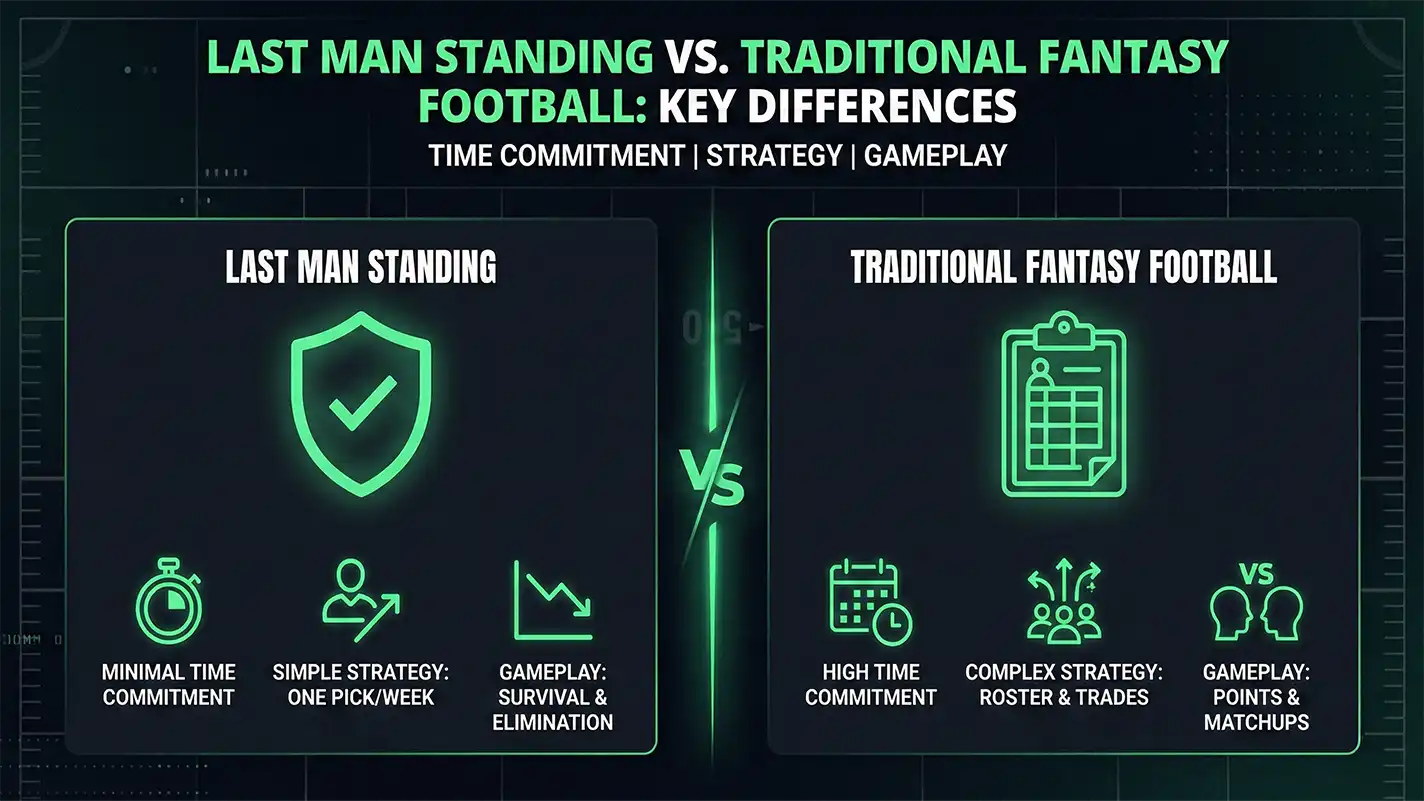
The fundamental difference lies in what each format tests. Fantasy Football tests your ability to build and manage a squad over time. Last Man Standing tests your ability to make strategic decisions under pressure.
| Aspect | Fantasy Premier League (FPL) | Last Man Standing |
|---|---|---|
| Time Commitment | High (5-10 hours/week) | Low (15-30 minutes/week) |
| Decisions/Week | Multiple (transfers, captain, bench) | One (single team pick) |
| Skill Factor | Moderate (squad building + management) | High (pure strategy) |
| Elimination Risk | None (play full season) | High (one bad pick ends run) |
| Win Criterion | Most points accumulated | Last person surviving |
| Cost to Compete | Time-intensive (free or paid) | Entry fee (£10-50) |
Let's break down what these differences actually mean for your experience as a player.
Deep Dive: What Each Difference Means for Players
Time Commitment: Hours vs. Minutes
Fantasy Football demands significant time investment. Pre-season squad building can take 2-3 hours. During the season, you're constantly monitoring injury news, form trends, fixture congestion, and transfer news.
Serious FPL players spend 5-10 hours per week managing their squads. That's a part-time job. Last Man Standing requires 15-30 minutes per week—analyze the fixtures, check your available teams, make your pick, and you're done.
Fantasy Premier League Weekly Routine
- • Check injury news (30 min)
- • Analyze fixtures & form (1 hour)
- • Make transfers (30 min)
- • Review player stats (1 hour)
- • Decide captain & vice-captain (30 min)
- • Track matches during gameweek (2+ hours)
Last Man Standing Weekly Routine
- • Review available teams (5 min)
- • Check win probabilities (5 min)
- • Analyze fixture context (5 min)
- • Make your pick (2 min)
- • Check results on match day (optional)
The time difference isn't just about convenience—it's about accessibility. Players with jobs, families, and other commitments can compete on equal footing in Last Man Standing. FPL favors those with the most free time.
Decision Frequency: Analysis Paralysis vs. Strategic Clarity
Fantasy Premier League requires dozens of decisions each week. Which forwards to pick? Which defenders to transfer in? When should I use my wildcard? Each decision carries weight, and each requires research.
Last Man Standing boils everything down to one binary decision: Which team wins this week? This clarity allows for deeper analysis of that single decision. You can research form trends, injury impacts, fixture difficulty, and historical performance—because you only have to do it once.
Strategic insight: Last Man Standing rewards depth over breadth. One well-researched decision beats twenty gut-feeling decisions every time.
The single-decision format also eliminates decision fatigue. In Fantasy Football, by Gameweek 10, you're exhausted from constant squad management. In Last Man Standing, you're just as engaged in Gameweek 15 as Gameweek 1—because the competitive pressure remains high and the workload stays manageable.
Skill Factor: Management vs. Strategy
Fantasy Premier League rewards two distinct skills: squad construction and ongoing management. You can build a strong squad but lose through poor transfer decisions. You can start with a weak squad but climb through smart transfers and captaincy choices.
Last Man Standing is pure strategy. No squad-building advantages. No transfer advantages. No lucky break from a surprise injury or breakout match. Every player starts fresh each week with access to the same information.
The skill in Last Man Standing lies in:
- Evaluating win probabilities accurately
- Managing your elite team usage across the season
- Identifying value picks that others miss
- Understanding fixture difficulty and context
- Calibrating risk based on your position in the pool
of LMS winners pick favorites less than 40% of the time
That statistic reveals the strategic depth of Last Man Standing. You can't just pick the best team every week—you'll run out of elite teams by Gameweek 8. Winners balance safety with future planning, differentiating from the pack when necessary.
Elimination Risk: Marathon vs. Sprint
Fantasy Premier League is a marathon. A bad gameweek doesn't end your season. You can have multiple low-scoring runs and still finish strongly. The format rewards consistency over 38 gameweeks.
Last Man Standing is a series of sprints where one stumble ends your race. This creates completely different psychology. Every week carries the same weight—the first gameweek matters as much as the thirty-eighth.
This elimination format creates something FPL lacks: genuine tension. When 50 players are down to 5, and everyone needs their team to win to survive, the collective anxiety is palpable. Fantasy Premier League has season-end tension; Last Man Standing has weekly tension.
Fantasy Premier League Advantage
Bad weeks don't eliminate you. Consistency matters more than perfection.
Last Man Standing Reality
One bad pick ends your season. Perfection is required every single week.
Win Criterion: Accumulation vs. Survival
Fantasy Premier League winners are determined by accumulation—most points scored over the season. You can have poor gameweeks and still recover. Consistency across 38 gameweeks yields the champion.
Last Man Standing winners are determined by survival. You don't accumulate anything—you simply avoid elimination. The winner isn't necessarily the "best" predictor; it's the player who avoided the upsets that eliminated everyone else.
Critical Difference
In Fantasy Premier League, you can win by being consistently above-average. In Last Man Standing, you must predict winners correctly until everyone else makes a wrong pick.
This creates a different competitive dynamic. In Fantasy Premier League, you're chasing points and managing transfers. In Last Man Standing, you're chasing correct predictions while watching your competitors fall. The satisfaction comes from outlasting others, not accumulating more points.
Pros and Cons: Each Format Has Its Place
Fantasy Premier League (FPL)
Pros:
- Forgiving format: Bad gameweeks don't end your season
- Deep engagement: Weekly involvement keeps you connected to the sport
- Multiple paths to victory: Can win through smart transfers, captain choices, or strategic wildcards
- Social experience: League communities, mini-leagues, head-to-head competitions
- Player-focused: Learn individual player form and fixtures deeply
Cons:
- Time-intensive: Requires 5-10 hours per week to compete seriously
- Advantages time-rich players: Those with more time have significant edge
- Analysis paralysis: Constant transfer decisions can lead to burnout
- Mid-season slumps: Poor early squad decisions can leave you struggling
- Complexity barrier: Steep learning curve for FPL mechanics and strategy
Last Man Standing Pools
Pros:
- Minimal time commitment: 15-30 minutes per week sufficient
- Accessible to busy players: Compete on equal footing regardless of time availability
- Pure strategy: Success comes from smart decisions, not time spent
- Weekly competition: Every week matters equally—no dead rubbers
- Simple rules: Beginners can compete immediately
- Leverageable skill: Data analysis provides tangible edge
Cons:
- Ruthless elimination: One bad pick ends your season
- Limited control: Can't control matchups or injuries
- Short season: Once eliminated, you're done for the year
- Less player engagement: Don't follow individual players as closely
- Variance plays role: Even perfect strategy can fall to upsets
Fantasy Premier League Is Best For
Players who enjoy deep squad management, following individual players, and weekly engagement with the sport.
Last Man Standing Is Best For
Players who love strategy, have limited time, and want high-stakes decisions every single week.
Which Format Is Right for You? A Decision Framework
You don't have to choose exclusively—many players enjoy both formats. But understanding your preferences helps you prioritize where to invest your energy.
Choose Fantasy Premier League If:
- You have 5+ hours per week to dedicate
- You love following individual players and their form
- You enjoy the social aspect of league communities and mini-leagues
- You want a season-long engagement with forgiveness for bad gameweeks
- You deeply enjoy squad management and transfer strategy
- You want to feel connected to the sport every single week
Choose Last Man Standing If:
- You have limited time but want meaningful competition
- You prefer strategy over management
- You want high competitive intensity every week, not just at the end
- You enjoy data analysis and probability assessment
- You want a format where skill reliably beats time investment
- You're tired of Fantasy Football burnout
Pro Tip
Start with Last Man Standing if you're new to competitive prediction games. The simple rules and low time commitment make it accessible, while still offering deep strategic depth.
The Hybrid Approach: Play Both
Many serious football fans participate in both formats simultaneously. They use Fantasy Football for weekly engagement and player form tracking, while Last Man Standing provides high-stakes strategic competition.
The formats complement each other well. Fantasy Football knowledge helps you understand team strength, fixtures, and player form—all valuable for Last Man Standing picks. Last Man Standing strategy teaches you probability thinking that can improve your FPL decisions.
Frequently Asked Questions
Is Last Man Standing easier than Fantasy Premier League?
Last Man Standing is simpler to learn but harder to master. The rules take minutes to understand, but consistently predicting winners requires deep strategic thinking. In Fantasy Premier League, you can compensate for mistakes with good transfers and management. In Last Man Standing, one wrong pick ends your season—regardless of how much you analyze.
Can I compete in Last Man Standing pools?
Yes. Last Man Standing pools are hosted by communities, friends groups, and platforms. Some pools are completely free to play, while others operate on an optional entry fee model (typically £10-50) where participants contribute to a shared pool and the winner or top finishers are recognized. The competitive appeal lies in skilled prediction and strategy, not financial returns. Many players join multiple pools throughout the season to maximize their competition opportunities.
Does Fantasy Premier League knowledge translate to Last Man Standing?
Partially. Fantasy Premier League knowledge about team strength, player form, and fixture difficulty absolutely helps in Last Man Standing. However, FPL rewards different skills—identifying form improvements, timing transfers well, and captain choices. Last Man Standing rewards evaluating win probabilities accurately and managing limited resources (elite teams) across a season. The football knowledge transfers, but the strategic mindset differs significantly.
What happens if I'm eliminated early from Last Man Standing?
Unlike Fantasy Premier League, where you're committed for a full season, elimination in Last Man Standing means you're done. This is why many players join multiple pools or participate in pools with buyback options (allowing eliminated players to re-enter for a fee). Some players also organize secondary pools that start after matchday 20 for eliminated players from the main pool.
Which format has more variance?
Last Man Standing has higher variance because one upset can end your season regardless of how well you've predicted. In Fantasy Premier League, a bad gameweek hurts but doesn't eliminate you—you can recover from variance over a longer timeline. However, skilled Last Man Standing players reduce variance through smart risk management and differentiation strategies.
Ready to Try Last Man Standing?
You now understand the key differences between Last Man Standing and Fantasy Premier League. You know the pros and cons of each format. You have a framework for deciding which suits your lifestyle and preferences.
The question is: do you want to spend hours managing a squad, or minutes making strategic predictions with meaningful competitive pressure?
Start Smarter
Outlast Labs provides the data-driven edge you need to excel. Win probabilities, form analysis, fixture context—all the information you need to make one smart decision each week. Stop guessing. Start predicting.
Create a free account and see what data-driven Last Man Standing strategy looks like. Your first pick is waiting.