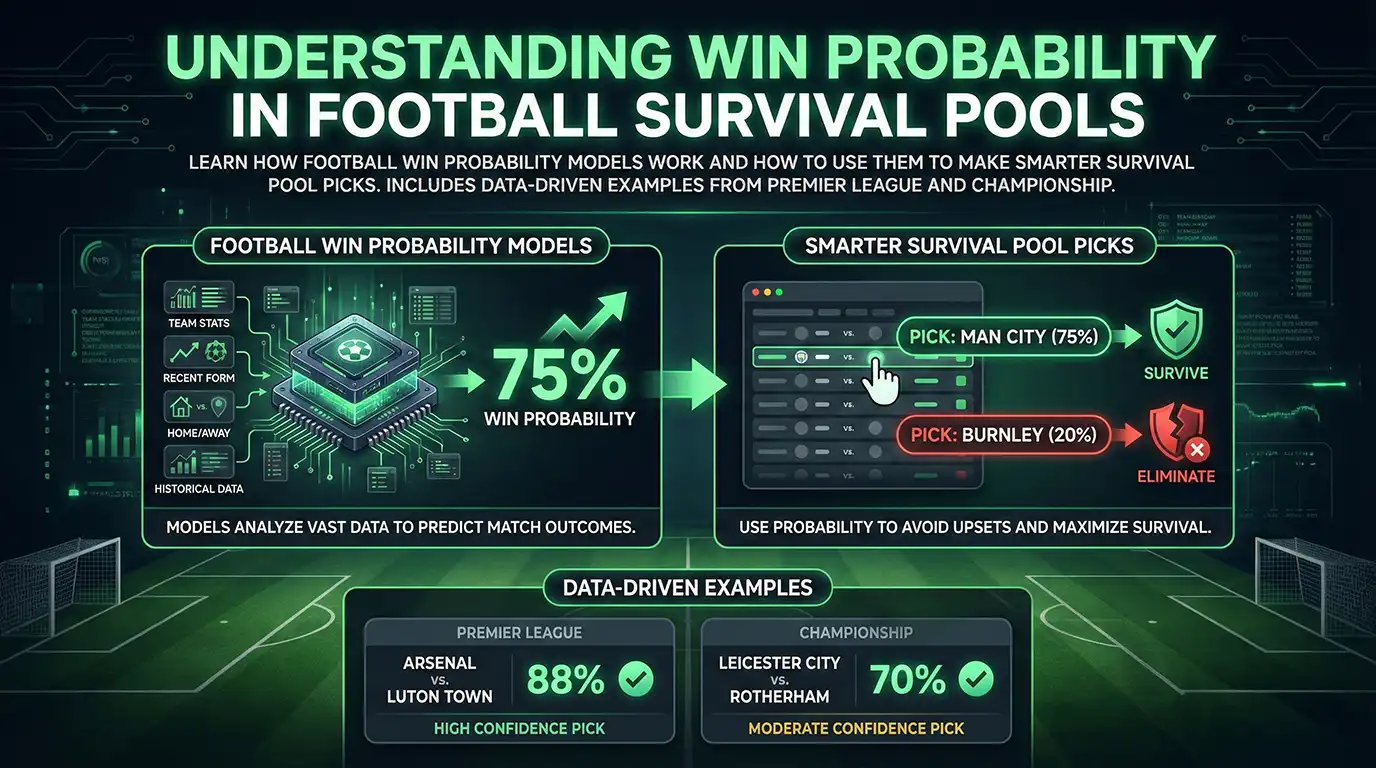
Understanding Win Probability in Football Survival Pools
Football win probability models have revolutionised how fans approach survival pools, transforming gut feelings into data-driven decisions. Whether you're competing in a workplace last-man-standing competition or analysing Fantasy Premier League (FPL) matchups, understanding win probability gives you a significant edge over competitors who rely on intuition alone.
Win probability isn't just about picking favourites—it's about identifying value, managing risk, and making calculated decisions that maximise your chances of survival throughout the season. In this comprehensive guide, we'll explore how football win probability works, how models calculate these percentages, and how you can leverage this data to make smarter picks in your survival pool.
What is Football Win Probability?
Win probability represents the likelihood of a particular outcome occurring in a football match, typically expressed as a percentage. In the context of survival pools, we focus primarily on the probability that a team will avoid defeat (win or draw), as this keeps you alive in the competition.
Unlike simple form tables or league position, win probability models incorporate multiple data points to produce a single, comprehensive metric. These models analyse historical performance, current form, head-to-head records, and various statistical factors to predict match outcomes with remarkable accuracy.
Home Advantage Impact
One of the most significant factors in football win probability is home advantage. Historically, home teams in the Premier League win approximately 65% of their matches, with roughly 20% ending in draws and 15% resulting in away victories. This statistical reality forms the foundation of most win probability models.
However, home advantage varies significantly between teams. Traditional "big six" clubs enjoy considerably higher home win rates against mid-table and bottom-half opposition, while matches between evenly matched teams see home advantage play a smaller role in determining the outcome.
How Models Calculate Win Probability
Modern win probability models use sophisticated algorithms that process vast amounts of data to generate accurate predictions. While different models may use unique methodologies, most rely on several core components:
1. Team Performance Metrics
- Expected Goals (xG): Measures shot quality and quantity to assess team performance beyond raw scores
- Form: Recent results over the last 5-10 matches, with more weight given to recent performances
- Goals For/Against: Both raw differentials and per-match averages
- Shooting and Defensive Efficiency: Conversion rates and chance quality conceded
2. Head-to-Head History
Historical matchups between teams often reveal patterns that pure statistics miss. Some teams consistently struggle against specific opponents regardless of current form, a phenomenon known as "bogey teams" in English football folklore.
3. Squad Availability
Injuries and suspensions significantly impact win probability, particularly when key players are unavailable. Models adjust their predictions based on:
- First-team player availability
- Goalkeeper injuries (particularly impactful)
- Captain and leadership absence
- Squad depth and quality of replacements
4. Contextual Factors
Premier League Win Probability Factors
| Factor | Weight in Model | Impact Range |
|---|---|---|
| Team Strength (xG difference) | 35% | ±25% |
| Recent Form (last 6 matches) | 25% | ±15% |
| Home Advantage | 20% | ±10% |
| Head-to-Head Record | 10% | ±8% |
| Squad Availability | 10% | ±12% |
Note: Weights and impacts vary by model and match context
Advanced models also consider contextual factors such as:
- Fixture congestion and rest days between matches
- European competition involvement (Champions League, Europa League)
- Weather conditions (extreme weather can affect playing style)
- Managerial changes and tactical adjustments
- Motivation factors (relegation battles, title races, cup competitions)
Why Win Probability Matters for Survival Pools
Survival pools—often called "last man standing" or "last woman standing" competitions—present unique challenges that make win probability particularly valuable:
Single Elimination Pressure
Unlike fantasy football where poor performances can be overcome, one incorrect pick eliminates you from survival pools. This zero-margin environment makes understanding the full spectrum of probabilities essential, not just identifying the biggest favourite each gameweek.
Long-Term Strategy
Successful survival pool participants look beyond the current gameweek. Using win probability data helps you:
- Conserve top teams: Avoid burning Manchester City or Liverpool at home in gameweek 3 when they might be needed in gameweek 15
- Identify value opportunities: Spot under-the-radar favourites with strong win probability but lower selection rates
- Plan fixture swings: Anticipate when traditionally strong teams face favourable runs of fixtures
Field Management
Understanding win probability helps you predict which teams your competitors will select. In many survival pools, avoiding popular picks can be advantageous—if the favourite loses, you survive while much of the field gets eliminated.
How to Use Win Probability in Pick Decisions
1. Establish Probability Thresholds
Set minimum win probability thresholds based on gameweek and stage of competition:
Recommended Win Probability Thresholds by Gameweek
| Gameweek Range | Minimum Win Probability | Rationale |
|---|---|---|
| Gameweeks 1-4 | 55% | Early season uncertainty, form not established |
| Gameweeks 5-15 | 60% | Mid-season stability, European competition impact |
| Gameweeks 16-30 | 65% | Fixture congestion, injuries accumulate |
| Gameweeks 31-38 | 70% | End-season intensity, motivation fluctuations |
2. Balance Probability and Team Conservation
The most challenging aspect of survival pools is balancing immediate survival with long-term sustainability. Use win probability to:
- Identify comparable alternatives: If Arsenal (75% win probability) face Chelsea, but Brighton (72%) host Bournemouth, Brighton offers similar survival probability while conserving Arsenal for later
- Predict favourable fixture runs: Teams transitioning from difficult runs to easy stretches become more valuable after gameweek 10
- Assess opponent quality: A 70% win probability against Manchester City differs significantly from 70% against a relegation candidate
3. Account for Variance
Even teams with 80% win probability lose one in five matches. Plan for variance by:
- Maintaining a mental "bank" of strong teams for difficult gameweeks
- Accepting calculated risks when win probabilities are compressed across multiple fixtures
- Recognising that survival to gameweek 20 beats being eliminated in gameweek 5 while chasing perfect picks
Data-Driven Examples from Premier League & Championship
Example 1: Favourite Trap (Gameweek 8, 2024/25 Season)
Scenario: Manchester City (90% win probability) host Arsenal while Newcastle (68%) host Wolves.
Analysis: Most survival pool participants select Manchester City, accepting the risk of elimination if the match ends in a draw. However, savvy players note that:
- Man City-Arsenal matches frequently end in draws (25% draw rate in last 20 meetings)
- Newcastle's home form against promoted sides exceeds 75% historically
- Field concentration on Man City means a Newcastle win advances you further relative to remaining competitors
Decision: Newcastle offers superior survival probability despite lower nominal win probability due to draw risk in the Man City fixture.
Example 2: Championship Complexity (Gameweek 12, 2024/25 Season)
Scenario: Leicester City (78% win probability) host Plymouth Argyle while Sunderland (72%) host Portsmouth.
Analysis: Championship survival pools require different thinking:
- Home advantage matters less than in the Premier League (away win rate ~30%)
- Form fluctuations are more pronounced—any team can beat any other on their day
- Leicester's quality warrants their higher probability, but Sunderland's home form against bottom-half teams makes them viable
Decision: Both selections offer strong survival probability; personal team conservation strategy becomes the deciding factor.
Example 3: The European Factor (Gameweek 15, 2024/25 Season)
Scenario: Liverpool (82% win probability) host Everton after playing in the Champions League three days prior, while Aston Villa (76%) host Crystal Palace with a full week of rest.
Analysis: Advanced models adjust for fixture congestion:
- Liverpool's win probability drops 8-12% when playing Champions League football within 72 hours of league matches
- Rest days significantly impact performance metrics—teams with 4+ more rest days win 65% of matches against congested opponents
- Villa's probability actually improves relative to baseline due to rest advantage
Decision: Aston Villa becomes the preferred selection despite lower nominal probability.
Advanced Win Probability Concepts
Probability Distribution vs. Single Point Estimate
Sophisticated models provide probability distributions rather than single percentages:
- Median projection: The most likely outcome (e.g., 75% win probability)
- Confidence interval: Range of likely outcomes (e.g., 68-82% win probability)
- Tail risk: Probability of extreme outcomes (e.g., 5% chance of heavy underperformance)
Understanding distributions helps you differentiate between stable 70% probabilities (narrow confidence interval) and volatile 70% probabilities (wide confidence interval).
Recency Bias vs. Regression to Mean
Human survival pool participants overreact to recent results:
- Teams coming off dramatic wins often underperform in subsequent matches
- Teams suffering heavy defeats frequently bounce back with improved performances
- Models that account for regression to mean consistently outperform those that weight recent form too heavily
Correlation Between Probability and Field Selection
In large survival pools, sometimes the optimal pick isn't the highest probability team but the one that maximises your relative position if you survive. This contrarian strategy becomes more valuable as:
- Field size increases (more competitors to eliminate)
- Season progresses (fewer strong teams available)
- Probability differences between top choices narrow
Common Mistakes When Using Win Probability
1. Treating Probability as Certainty
A team with 80% win probability still loses one in five matches. Plan for variance, don't assume certainty.
2. Ignoring Draw Probability
Many survival pools eliminate you on a draw. A 75% win probability with 20% draw probability is worse than a 70% win probability with 15% draw probability.
3. Overweighting Recent Results
Form is important, but don't chase last week's standout performers. Quality and underlying metrics matter more than one exceptional match.
4. Neglecting Team Conservation
Picking Manchester City at home in gameweek 2 might guarantee survival this week, but eliminates your best option for difficult gameweeks later in the season.
5. Disregarding Championship Differences
Championship survival pools require different probability thresholds and expectations due to higher variance and lower home advantage.
Frequently Asked Questions
What is a good win probability threshold for survival pools?
For Premier League survival pools, aim for minimum 60% win probability in the early season (gameweeks 1-10), 65% in mid-season (gameweeks 11-25), and 70% in the final stretch (gameweeks 26-38). Championship pools require slightly lower thresholds (55-60%) due to increased variance.
How accurate are football win probability models?
The best models correctly predict outcomes approximately 70-75% of the time for clear favourites (teams with 70%+ win probability). However, even the best models cannot predict upsets with high accuracy—this is football's inherent beauty and frustration.
Should I always pick the team with the highest win probability?
No. Survival pool success requires balancing immediate survival with long-term sustainability. Sometimes selecting a team with slightly lower probability conserves a stronger option for difficult gameweeks ahead. Additionally, contrarian picks can provide strategic advantage when large portions of the field select the same team.
How does European competition affect win probability?
Teams participating in Champions League, Europa League, or Conference League typically see their win probability drop 8-12% for matches played within 72 hours of European fixtures. Fatigue, rotation, and mental focus all contribute to this decline.
Why do Championship matches have higher variance?
The Championship features more competitive balance than the Premier League, with less disparity between top and bottom teams. Home advantage matters less, and form fluctuates more dramatically, making outcomes harder to predict with high confidence.
Can win probability help with Fantasy Premier League (FPL) decisions?
Absolutely. While survival pools focus on avoiding defeat, FPL players benefit from understanding which teams are likely to score heavily and keep clean sheets. Win probability models inform captain choices, transfer targets, and benching decisions throughout the season.
How often do big favourites actually lose in survival pools?
Historical data shows that teams with 80%+ win probability still lose approximately 15-20% of matches. In a typical 38-game Premier League season, you should expect 2-3 "shock" results where heavy favourites drop points. Plan your survival pool strategy accordingly.
What's the difference between win probability and draw probability?
Win probability specifically refers to the likelihood of a team winning the match. Draw probability represents the chance of a level scoreline. In survival pools where draws eliminate you, the relevant metric is "win avoid defeat probability" (win probability + draw probability).
How important is home advantage in survival pool decisions?
Home advantage is the single most significant factor in football win probability. Home teams win approximately 65% of Premier League matches historically, making home fixtures considerably more attractive for survival pool selections. However, the magnitude of home advantage varies between teams—top teams enjoy greater home advantage than mid-table sides.
Should I change my strategy for Championship survival pools?
Yes. Championship survival pools require adjusted expectations due to higher variance and lower predictability. Set lower win probability thresholds (55-60%), be more willing to accept calculated risks, and recognise that any team can beat any other on their day. Home advantage matters less, and form fluctuations are more pronounced.
Conclusion
Understanding win probability transforms survival pools from games of chance into strategic challenges where knowledge and decision-making separate consistent performers from one-season wonders. By incorporating data-driven insights into your selection process, you gain a significant edge over competitors who rely on gut instinct and favouritism.
Remember: survival pools aren't about being perfect—they're about surviving longer than your competitors. Sometimes that means picking the safest option, sometimes it means taking calculated risks, and sometimes it means thinking contrarianly to gain relative advantage.
The most successful survival pool participants blend analytical rigour with strategic flexibility. Use win probability as your foundation, but adapt your approach based on field dynamics, team availability, and the unique challenges presented by each gameweek throughout the long Premier League and Championship seasons.