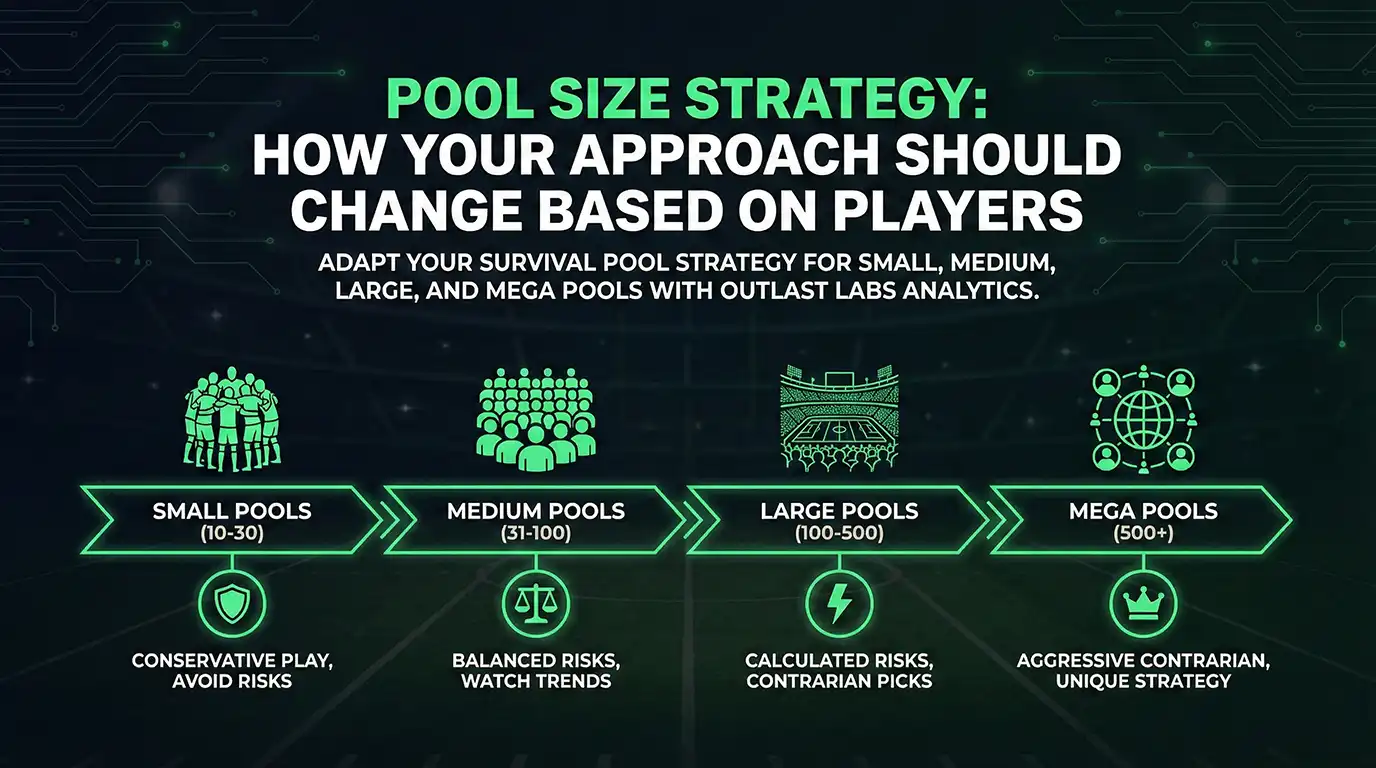
Why Pool Size Changes Everything
The same pick that wins you a 20-person office pool might eliminate you by Week 3 in a 500-player public competition. Yet most players use the exact same strategy regardless of pool size — and that's why they lose.
Pool size is the single most important factor in determining your optimal strategy. It dictates how much you need to differentiate from the field, what risks you should take, and whether survival or separation should drive your decisions.
In small pools, you're playing against basic human error. In large pools, you're competing against sharp players who understand game theory. In mega pools, you need game-breaking contrarian plays just to survive the attrition.
This guide shows you exactly how to adapt your approach based on your pool size, with specific strategies for each tier and data-driven frameworks for making smarter picks.
The Risk/Reward Spectrum Across Pool Sizes
Before diving into specific strategies, let's establish the fundamental relationship between pool size and optimal play:
The key principle: As pool size increases, differentiation becomes more important than survival probability. In small pools, you're trying to not be the idiot who picks a losing underdog. In large pools, you're trying to be the genius who avoids the field-eliminating upset.
The Golden Rule of Pool Size Strategy
In any pool, your edge comes from either (a) surviving when others don't, or (b) being different when the chalk loses. Small pools reward (a). Large pools reward (b). Adjust accordingly.
Small Pools (10-30 Players): Conservative Strategy
In small pools, you're primarily competing against human error — missed deadlines, bad gut feelings, emotional picks, and basic misunderstanding of probability. Your strategy should be simple: maximize your survival probability and let others eliminate themselves.
Core Principles
1. Survival is everything. With only 10-30 players, you don't need to differentiate. If you survive while 3-5 others get eliminated each week, you'll naturally reach the final 3-5 players regardless of your specific picks.
2. Pick the highest win probability team available. Don't overthink it. If Man City is 85% to win against a bottom-table team, that's your pick. The 2-3% edge you might gain from a clever contrarian play isn't worth the elimination risk.
3. Ignore pick distribution. In a 20-person pool, if 15 people pick the same team and that team loses, you just eliminated 75% of your competition. You want to be on the opposite side of that.
Small Pool Strategy Framework
Weeks 1-6: Pick the safest available team regardless of popularity. Target 85%+ win probability.
Weeks 7-12: Continue survival focus. You can afford slightly more risk (75%+ win probability) if you've preserved top teams.
Weeks 13+: Survival still priority, but start considering pick distribution if 3+ players remain.
When to Take Risks in Small Pools
There are only two scenarios where you should deviate from survival-first strategy:
- Late game (final 3-4 players): If you've burned your elite teams and others haven't, you may need to accept 65-70% win probability to preserve teams for later weeks.
- Elite team preservation: If you're the only one who hasn't used Man City/Arsenal/Liverpool, and they have an easy matchup, consider waiting for a better spot — but only if the alternative is still 75%+ to win.
Small Pool Example
You're in a 25-person pool. It's Week 4. Man City (85% win probability) is playing against Luton Town. Brighton (72% win probability) is playing against Crystal Palace.
The data-driven pick: Man City, even if 15 other players pick them. If Man City loses, you eliminate 60% of your competition. If Brighton loses, you're eliminated while most Man City pickers survive.
Small Pool Mistake to Avoid
Trying to be clever with contrarian picks. In small pools, smart often equals eliminated. Save the game theory for when you actually need it.
Medium Pools (31-100 Players): Balanced Approach
Medium pools are the transition zone where both survival and differentiation matter. You need to survive, yes — but you also need to start thinking about pick distribution, especially as the pool shrinks and skilled players remain.
Core Principles
1. Survival-first, with calculated differentiation. Early season (Weeks 1-8), prioritize 80%+ win probabilities. As the pool shrinks below 30 players, start targeting 30-40% pick differentiation on teams with 75%+ win probability.
2. Monitor pick distribution by Week 5. In most medium pools, public picks stabilize by Week 4-5. Start tracking which teams the field is targeting and look for opportunities to be different on similarly-safe teams.
3. Preserve 2-3 elite teams for the final 4 weeks. Unlike small pools, you can't just pick the best team every week. You need to think about team availability when you're down to the final 5-10 players.
Medium Pool Strategy Framework
Weeks 1-4: Pure survival mode. Pick the highest win probability team available (80%+ target).
Weeks 5-8: Begin monitoring pick distribution. Target 20-30% differentiation when win probability is within 5% of the chalk.
Weeks 9-12: Increase differentiation target to 30-40%. Consider team preservation for final weeks.
Weeks 13+: Game theory becomes critical. Avoid being on the same side as >50% of remaining players.
When to Differentiate in Medium Pools
Look for these opportunities to be different without sacrificing too much survival probability:
- Similar win probability, less popularity: If Team A is 82% to win with 60% of picks, and Team B is 78% to win with 25% of picks, Team B is often the better choice in pools >50 players.
- High-variance weeks: Weeks with multiple favorites (e.g., FA Cup weekends, international break weekends) create opportunities for differentiated plays.
- When 30-40% of the pool remains: This is when differentiation starts mattering more than raw survival probability.
Medium Pool Example
You're in a 75-person pool. 30 players remain (Week 8). Arsenal is 80% to win against Everton, and 45% of remaining players have picked them. Liverpool is 77% to win against Wolves, and only 20% of players have picked them.
The balanced pick: Liverpool. You're sacrificing only 3% survival probability to gain 25% differentiation. If Arsenal wins (likely), you survive anyway. If Arsenal loses (unlikely), you eliminate nearly half your competition.
Medium Pool Mistake to Avoid
Differentiating too early. Before Week 5, survival probability is still king. Save the contrarian plays for when the pool has thinned and skill levels have risen.
Large Pools (100+ Players): Contrarian Strategy
Welcome to the deep end. In large pools, you're not just competing against mistakes — you're competing against sharp players who understand pick distribution, game theory, and variance. Your strategy must fundamentally shift from survival to differentiation.
Core Principles
1. Avoid the chalk at all costs. "The chalk" refers to the most popular picks of the week. In large pools, being on the chalk is a double-edged sword: if the chalk wins, you gain nothing (survive with 80% of the pool); if the chalk loses, you're eliminated along with 50%+ of players.
2. Target 30-40% pick differentiation. Your goal is to pick teams that only 10-30% of the field is selecting, ideally with win probabilities within 5-10% of the chalk.
3. Embrace variance strategically. In large pools, you need to survive the early weeks AND differentiate enough to reach the final 5-10 players. This means taking calculated risks — 65-75% win probabilities — when the differentiation upside is significant.
Large Pool Strategy Framework
Weeks 1-3: Survival mode with eyes open. Pick 75%+ win probability teams, but start monitoring pick distribution patterns.
Weeks 4-8: Begin contrarian plays. Target teams with 30-40% of picks when win probability is within 5% of chalk.
Weeks 9-12: Full differentiation mode. Avoid being on >30% of any side. Target 20-30% pick share.
Weeks 13+: Game theory optimal. Target extreme differentiation (10-20% pick share) while maintaining 65%+ win probability.
The Chalk Avoidance Framework
Here's a practical framework for avoiding the chalk in large pools:
- Identify the chalk: By Week 4-5, you'll see clear patterns in pick distribution. The top 2-3 teams each week usually draw 40-60% of picks combined.
- Find alternative value: Look for teams with 70-80% win probability that only 10-25% of players are selecting.
- Calculate risk/reward: If chalk team is 85% to win and alternative is 78% to win, you're sacrificing 7% survival probability. Is the differentiation upside worth it? In large pools, usually yes.
- Track your burn rate: Because you're avoiding chalk, you'll burn through good teams faster. Plan your elite team usage accordingly.
Large Pool Example
You're in a 200-person pool. 80 players remain (Week 6). Man City is 85% to win against Bournemouth, and 55% of remaining players have picked them. Aston Villa is 76% to win against Sheffield United, and only 15% of players have picked them.
The contrarian pick: Aston Villa. You're sacrificing 9% survival probability, but you're positioning yourself to eliminate 55% of the remaining pool if Man City loses. In a 200-person pool, that's a trade worth making.
Advanced Large Pool Tactic: The Deferred Elite
When 3+ elite teams (Man City, Arsenal, Liverpool) have easy matchups in the same week, consider picking a slightly weaker team to defer your elite team usage to a week when they're the only obvious chalk. This maximizes your future differentiation opportunities.
Mega Pools (500+ Players): Game Theory Optimal
In mega pools, you're playing a different game entirely. You need to survive 15-20 weeks of attrition against hundreds of sharp players, then differentiate enough to reach the final 3-5 players from a pool that started with 500+ people. This requires embracing variance and making game-breaking contrarian plays.
Core Principles
1. Early season: Survival with variance tolerance. Weeks 1-6, pick 70-75% win probability teams and accept that you might get eliminated. The upside is surviving while 60-80% of the mega-pool burns on the chalk.
2. Mid-season: Extreme differentiation. Weeks 7-12, target teams with only 10-20% of picks. You're not trying to survive every week — you're trying to survive weeks when the chalk loses.
3. Late season: Game theory optimal. When 10-20 players remain from 500+, you need to think multiple moves ahead. What will the remaining 5-10 players do? How can you position yourself to be different from all of them?
Mega Pool Strategy Framework
Weeks 1-4: Survival acceptable range (70%+ win probability). Accept higher variance to avoid being on the chalk.
Weeks 5-8: Target extreme differentiation (15-25% pick share). Burn good teams early to preserve future flexibility.
Weeks 9-12: Pure contrarian approach. Avoid teams with >30% pick share regardless of win probability.
Weeks 13+: Multi-step game theory. Predict what remaining players will do and position accordingly.
The Mega Pool Paradox
Here's the counterintuitive reality of mega pools: you need to take more risks to survive longer. Why? Because in a 500-person pool, if 50% pick Man City and Man City loses, 250 people are eliminated. If you're one of the 250 who picked Villa (75% win probability) instead, you've just gained a massive advantage.
Over 15-20 weeks, the chalk will lose 2-3 times. Each time, 40-60% of the pool gets eliminated. Your goal is to be on the opposite side of those eliminations, even if it means accepting slightly lower survival probability each week.
Mega Pool Example
You're in a 1,000-person pool. 400 players remain (Week 7). Liverpool is 88% to win against Fulham, and 65% of remaining players have picked them. Newcastle is 74% to win against Luton, and only 12% of players have picked them.
The game theory pick: Newcastle. You're sacrificing 14% survival probability, but you're positioning to eliminate 65% of the remaining pool if Liverpool loses. In a mega pool, that's the only way to reach the final 5-10 players.
Mega Pool Mental Shift
Stop trying to survive every week. Start trying to survive the right weeks. In mega pools, you're not playing to not lose — you're playing to be different when the chalk explodes. Accept that you might get eliminated early. The upside is reaching the final table with massive differentiation equity.
Decision Framework: Quick Guide for Your Pool Size
Use this quick reference guide to adapt your strategy based on your specific pool size and week number:
| Pool Size | Weeks 1-4 | Weeks 5-8 | Weeks 9-12 | Weeks 13+ |
|---|---|---|---|---|
| 10-30 players | 85%+ win prob | 80%+ win prob | 75%+ win prob | Monitor picks if 3+ remain |
| 31-100 players | 80%+ win prob | 20-30% differentiation | 30-40% differentiation | Game theory critical |
| 101-500 players | 75%+ win prob | 30-40% differentiation | Avoid chalk (>30% picks) | 20-30% pick share target |
| 500+ players | 70%+ win prob, accept variance | 15-25% pick share | Extreme contrarian | Multi-step game theory |
Key Metrics by Pool Size
How to Adjust Mid-Season
Pool dynamics change as players get eliminated. Here's how to adapt:
- Track remaining players weekly: Know exactly how many players are left and what the pick distribution looks like.
- Shift strategies as pool shrinks: A 100-player pool that's down to 25 players should now be played with small pool tactics.
- Monitor skill level of remaining players: As weak players get eliminated, remaining players tend to be sharper. Adjust by increasing differentiation.
- Watch for buybacks: If your pool allows buybacks, treat them as new players joining mid-season. They're typically less strategic and more likely to pick chalk.
Frequently Asked Questions
How do I know my exact pool size?
Ask your pool commissioner for the final player count before the season starts. Public pools often show participation numbers on the leaderboard or standings page.
What if my pool size falls between categories (e.g., 95 players)?
Round up and use the larger pool strategy. A 95-player pool behaves more like a 100-player pool than a 50-player pool because you still need significant differentiation to reach the final 3-5 players.
Should I change strategy if I get a strike/buyback?
Yes — treat strikes as an opportunity to be more aggressive. In a strike pool, you can take calculated risks earlier because you have a safety net. Adjust your win probability targets down by 5-10%.
What if I'm in multiple pools of different sizes?
Optimize each pick for each pool separately. Don't use the same pick across all pools — that defeats the purpose of understanding pool size strategy. Use Outlast Labs to track picks across multiple pools.
How do I find pick distribution data for my pool?
Public pools often show pick distribution on the platform. Private pools may require asking your commissioner to share pick percentages. If data isn't available, assume the most popular teams (Man City, Arsenal, Liverpool) will draw 40-60% of picks.
Is pool size more important than strike rules or buybacks?
Pool size is the primary driver of strategy. Strike rules and buybacks are secondary factors that modify your approach within the pool size framework. Always start with pool size, then adjust for other rules.
What's the biggest mistake players make in large pools?
Playing small pool tactics in a large pool. Picking the chalk every week might get you to Week 10, but you'll be one of 50 remaining players with no differentiation equity. You need contrarian plays to reach the final 3-5.
Can I win a large pool with small pool strategy?
It's possible, but you're relying on luck. In a 200-player pool, if you pick chalk every week and survive, you'll likely be one of 20-30 remaining players late in the season. At that point, you're playing coin flip games against other skilled players. Contrast that with a contrarian approach that reaches the final 5-10 players with maximum differentiation equity.
How does strategy differ between Premier League and Championship pools?
The core principles remain the same across both leagues. However, Championship pools have higher variance due to more unpredictable outcomes and greater parity between teams. This means you should embrace differentiation even more aggressively in Championship pools of all sizes.
Should I ever pick a team with <65% win probability?
Only in mega pools (500+ players) and only when you're targeting extreme differentiation (10-15% pick share). For most players in most pools, 65% win probability is too risky. Stick to 70%+ unless you're specifically trying to be different from the field.
Ready to Apply Pool Size Strategy?
Understanding how your pool size should dictate strategy is the difference between casual players and consistent winners. Small pools reward survival. Large pools reward differentiation. Mega pools reward game theory and calculated risk-taking.
Your next step: identify your pool size, commit to the appropriate strategy framework, and make picks that align with your competitive landscape.
Outlast Labs provides win probabilities, pick distribution tracking, and team management tools specifically designed to help you execute the right strategy for your pool size. Stop playing one-size-fits-all tactics. Start playing optimal strategy for your specific pool.
If you are still building your foundation, read how Last Man Standing pools work, learn which rule variations change the optimal approach, and use this companion list of common elimination mistakes as a pre-pick checklist each week.