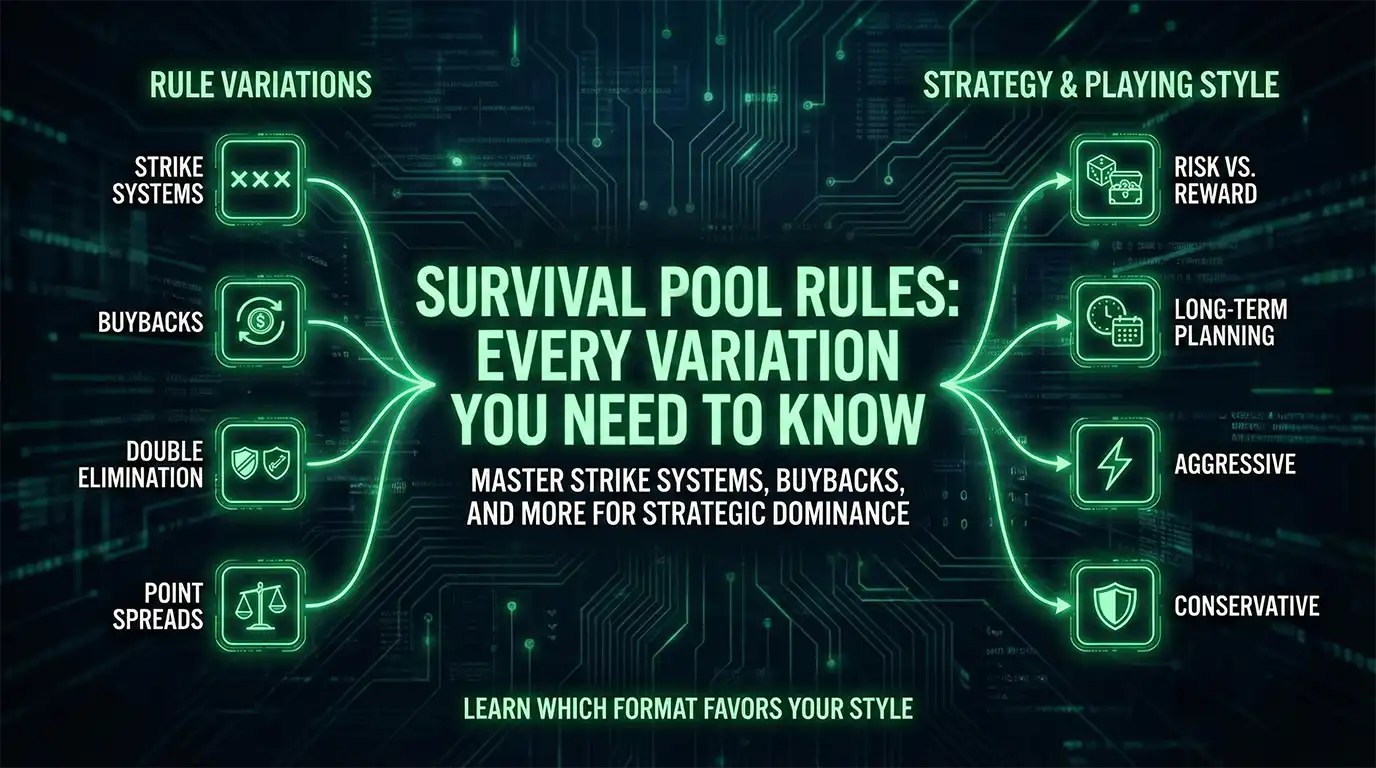
You join a survival pool with confidence. You've done your research. You know the teams. Then Week 3 hits, and suddenly half the pool is eliminated by a rule variation nobody mentioned.
Different rules can eliminate you if you're not prepared.
Most players assume all Last Man Standing pools work the same way. They don't. Strike systems, buybacks, point spreads, double elimination weeks — each variation changes the game completely. What wins in one pool might get you eliminated in another.
This guide covers every common rule variation you'll encounter, how each affects your strategy, and what to look for before you join.
Base Rules: Standard Last Man Standing Format
Before diving into variations, you need to understand the baseline. Standard Last Man Standing rules are simple:
- Pick one team to win each week
- If your team wins, you advance
- If your team loses or draws, you're eliminated
- You cannot pick the same team twice
- Last player standing wins
Everything else — strikes, buybacks, spreads — builds on this foundation. The variations you encounter will either make the game more forgiving or more challenging. Understanding which direction your pool leans determines your entire approach.
Common Rule Variations: Complete Breakdown
1. Strike System
Instead of instant elimination, strike pools give you 1-2 chances to survive a bad week. One wrong pick doesn't end your season — you lose a strike instead. You're only eliminated after using all your strikes.
Strike System
Get 1-2 strikes before elimination
Impact: More forgiving, extends season
One-strike pools are the most common format. Two-strike pools are significantly more forgiving and often extend the season deeper into the schedule. Three-strike pools exist but are rare — they eliminate most of the survival tension.
Strategy Impact
Can afford calculated risks in strike pools. If you have two strikes, you might take a gamble on an underdog in Week 5 rather than burning an elite team you'll need later. In zero-strike pools, survival always trumps upside.
2. Double Elimination Weeks
Certain weeks require you to pick two winning teams instead of one. Both must win for you to advance. Commissioners often schedule these weeks around high-stakes matchdays or holiday fixtures when more games are available.
Double Elimination Weeks
Must pick two winning teams in specific weeks
Impact: Doubles elimination risk, tests depth
Double pick weeks dramatically increase elimination probability. Even if you pick two heavy favorites, upsets happen. Pools with double pick weeks typically see their largest single-week eliminations during these rounds.
Strategy Impact
You need two separate teams that week, not one strong team and a risky second pick. Consider using safer, lower-tier teams rather than two elite options — preserving your best teams for future single-pick weeks matters more than surviving one double week at all costs.
3. Point Spread Requirements
Standard pools only care about winning. Advanced pools sometimes require your team to win by a minimum margin — commonly 2+ goals for Premier League and Championship pools. Your team can win outright, but if they don't meet the margin requirement, you're eliminated.
Point Spread Requirements
Team must win by specified margin
Impact: Makes favorites riskier, underdogs nearly unplayable
Spread requirements change everything. A 1-0 victory counts as a loss if your pool requires a 2-goal margin. This dramatically increases variance — even elite teams win by one goal constantly. You'll need to research margin-of-victory trends, not just win percentages.
Strategy Impact
Prioritize teams that win convincingly, not narrowly. High-scoring teams with strong defenses are safer than low-scoring defensive specialists. Avoid picking away teams even if they're favored — they rarely win by large margins.
4. Buyback Options
Buyback rules allow eliminated players to re-enter the pool for a fee. The fee typically adds to the prize pool, making the eventual prize larger while giving players a second chance.
Buyback Options
Pay fee to re-enter after elimination
Impact: Keeps players engaged, increases prize pot
Some pools limit buybacks to one per player. Others allow unlimited buybacks until a certain week. A few pools don't allow buybacks at all — you're out, you're out.
Strategy Impact
If buybacks are allowed, you can afford slightly more risk knowing you have a safety net. But buyback fees add up — don't treat them as insurance. The best strategy remains avoiding elimination in the first place.
5. Pick Protection / Carryover Rules
Some pools protect your pick under specific circumstances. The most common protection is injury-related: if your picked team's starting goalkeeper gets sent off in the 10th minute and they collapse, your pick might carry over to the next week as if you never made it.
Pick Protection / Carryover
Bad picks carry over under specific conditions
Impact: Reduces bad luck elimination, reduces variance
Protection rules vary wildly. Some pools protect against early red cards. Others protect against postponed matches. A few pools protect against anything deemed "extraordinary circumstances." Make sure you understand exactly what your pool considers protectable.
Strategy Impact
Protection rules reduce variance, which favors better strategy. You can pick teams with volatile injury situations knowing you won't get eliminated by freak events. But don't rely on protection — it's designed for genuine bad luck, not calculated risks.
6. Reverse Elimination (Worst-to-First)
Instead of eliminating players who pick losers, reverse pools eliminate players who pick winners. You want your team to lose or draw. Last player remaining who hasn't picked a winner wins.
Reverse Elimination
Picked teams must lose to advance
Impact: Completely inverted strategy, favors underdog picks
This format completely inverts standard strategy. You're hunting for teams likely to lose or draw. The strongest teams in the league become the most dangerous picks — you're eliminated if they win.
Strategy Impact
Target struggling teams, especially those facing elite opposition. Draws are your friend — many bottom-half teams draw 30-40% of their matches. Avoid the bottom three entirely; they might surprise you and cost you the pool.
7. Group Stage Formats
Instead of instant elimination, players compete in groups for the first several weeks. Top performers from each group advance to a knockout phase. This format combines league-style survival with bracket-style elimination.
Group Stage Format
Group phase precedes knockout elimination
Impact: Multiple lives early, survival pressure later
Group stage pools often use points systems (3 points for a correct pick, 0 for wrong) or allow one strike during the group phase. Only after 4-6 weeks of group play does single-elimination begin.
Strategy Impact
Group play allows early risk-taking since you're not instantly eliminated. But conserve your best teams for the knockout phase — you'll need them when single-elimination starts and half the pool is gone.
8. Cross-League Pools
Most pools restrict picks to a single league. Cross-league pools allow you to pick from multiple competitions — Premier League one week, Championship the next, La Liga the week after. This dramatically expands your available teams.
Cross-League Pools
Can pick teams from multiple leagues/competitions
Impact: More options, requires broader knowledge
The advantage is obvious — you never run out of quality teams. The disadvantage is complexity — you need to track form, injuries, and fixture difficulty across multiple leagues. Casual players often struggle with cross-league formats.
Strategy Impact
Cross-league pools favor players with broad football knowledge. You can exploit league-specific inefficiencies — most players stick to teams they know, leaving quality picks in smaller leagues unselected. Use this to your advantage.
9. Deadline Variations
Standard pools require all picks before the first match of the gameweek. Some pools allow rolling deadlines — you can pick any team whose match hasn't started yet. This creates strategic advantages for late games.
Deadline Variations
Rolling deadlines vs. single weekly deadline
Impact: Late-game info advantage, more schedule flexibility
Rolling deadlines reward paying attention. You can wait for early results before committing to a late game. If heavy favorites win early, you might take a risk on a late underdog to differentiate. If upsets eliminate half the pool, you can play conservatively.
Strategy Impact
With rolling deadlines, prioritize late games when possible. They give you maximum information and flexibility. But don't wait too long — late kickoffs might conflict with your sleep schedule or other commitments.
10. Autopick Rules
Some pools eliminate you immediately if you forget to submit a pick. Others use autopick — if you miss the deadline, the system automatically assigns you a team (usually a heavy favorite you haven't used yet).
Autopick Rules
Automatic team assignment if deadline missed
Impact: Prevents forgetful elimination, burns premium teams
Autopick prevents careless eliminations but costs you control. The system might burn Manchester City in Week 7 when you were saving them for a must-win situation later. You survive, but your strategic position weakens.
Strategy Impact
Never rely on autopick intentionally. Set calendar reminders for deadlines. If your pool has autopick, assume it will make the worst possible strategic choice from your perspective — because it might.
Strategy Implications by Rule Type
Different rule variations reward different playing styles. Understanding which rules favor your strengths helps you choose the right pools and avoid ones that exploit your weaknesses.
Risk Tolerance Matching
Strike pools, buybacks, and group stages all reduce the cost of failure. They reward aggressive players willing to take calculated risks for differentiation. If you trust your research and want to separate from the pack, seek out these formats.
Instant elimination, spread requirements, and double pick weeks all increase failure costs. They reward conservative survival-first players. If you prefer grinding down the field through steady survival, standard zero-strike pools are your edge.
Knowledge Base Alignment
Cross-league pools reward broad football knowledge across multiple competitions. If you follow La Liga as closely as the Premier League, you have a significant advantage over single-league specialists.
Single-league pools reward deep, focused knowledge. If you know everything about one league — injuries, form trends, tactical matchups — you'll outperform casual players who recognize big names but miss contextual details.
Time Commitment Considerations
Rolling deadline pools require weekly monitoring and late-week decision-making. If you can check lineups and early results before making late picks, you gain an information advantage time-poor players can't match.
Single deadline pools reward planning ahead. If you prefer setting your picks Thursday and walking away, standard pools fit your schedule better than formats requiring constant attention.
Which Rules Favor Which Players
Not all rule variations are equal — some heavily favor skilled players, while others introduce randomness that helps casuals. Knowing which is which helps you choose +EV pools.
Skill-Favoring Rules
- Single deadline: Rewards preparation and research over last-minute reactions
- No buybacks: Serious players treat every pick as critical; casuals get eliminated and stay eliminated
- Cross-league format: Rewards broad football knowledge and research ability
- Spread requirements: Most casuals don't understand margin-of-variance analytics
- Group stages with points: Multi-week consistency outperforms lucky streaks
Variance-Favoring Rules
- Strike systems: Give bad players extra chances to luck into survival
- Buybacks: Allow bad players to purchase second chances
- Double elimination weeks: Introduce massive variance regardless of skill
- Rolling deadlines: Reduce the planning advantage serious players build
- Reverse elimination: Completely random — elite teams constantly win unexpectedly
Player Type Edge Detection
Serious analytical players should seek single-league, single-deadline, no-strike pools. Casual players should look for strike systems, buybacks, and cross-league formats that level the playing field. Honest self-assessment saves you money — don't join pools where you're structurally disadvantaged.
Commissioner's Corner: Choosing the Right Rules
If you're running a pool, rule selection determines player experience. Get it wrong and players won't return next season. Here's how to choose rules that match your pool's goals.
Goal: Maximum Engagement (Office Pools, Friend Groups)
You want everyone involved until late in the season. Strikes and buybacks are your friends — they keep casual players alive longer. Cross-league formats keep things interesting when single-league options thin out. Avoid double elimination weeks that wipe out half the pool in one weekend.
Goal: Pure Skill Competition (Serious Player Groups)
Remove randomness. Single deadlines, no strikes, no buybacks, single league. Let the best strategist win. Consider group stages with points systems to reward consistency over luck. Your players want meritocracy, not safety nets.
Goal: Large Prize Pools (Public Commercial Pools)
Balance accessibility with credibility. One strike keeps beginners from rage-quitting after Week 2. Limited buybacks (one per player, cutoff after Week 8) generate revenue while maintaining competitive integrity. Avoid exotic formats like reverse elimination that confuse casual players.
Goal: Quick Season (Short Attention Spans)
Double elimination weeks, no strikes, single elimination. Your goal is rapid attrition to reach a winner quickly. Consider group stages with smaller groups to accelerate the knockout phase.
Commissioner Pro Tip
Write rules explicitly and distribute them before the season starts. Ambiguity creates disputes. Specify strike counts, buyback fees and deadlines, double pick weeks in advance, and what happens if all remaining players eliminate in the same week. Clear rules prevent angry arguments later.
Rule Variation Comparison Grid
| Rule Variation | Variance | Skill Edge | Best For |
|---|---|---|---|
| Standard (0 strikes) | Low | High | Serious players |
| 1-strike system | Medium | Medium | Balanced groups |
| 2-strike system | High | Low | Casual players |
| Point spreads | High | High | Analytics players |
| Double pick weeks | Very High | Low | Quick seasons |
| Cross-league | Medium | High | Knowledgeable players |
| Buybacks allowed | Medium | Medium | Large prize pools |
| Reverse elimination | Very High | Very Low | Novelty formats |
Frequently Asked Questions
What's the fairest rule format for a serious competition?
Single-league, zero-strike pools with a single weekly deadline. This format minimizes variance and maximizes the advantage of research, planning, and strategic thinking. Casuals might complain about harshness, but serious players respect the meritocracy.
Should I join a pool with buybacks?
Depends on your budget and goals. Buybacks keep you in the game but cost additional money. If you're playing casually and want maximum entertainment, buybacks extend your season. If you're playing seriously and want positive EV, buyback fees reduce your ROI even if you win.
Are cross-league pools harder than single-league?
They're more time-consuming, not necessarily harder. If you only follow one league, cross-league formats require additional research that disadvantages you. If you're a multi-league fan already, cross-league pools give you more options and exploit single-league specialists' blind spots.
How do double elimination weeks affect strategy?
They force you to burn two teams in one week, accelerating resource depletion. Smart players save their absolute safest teams for double weeks and avoid using two premium options unless necessary. The goal is surviving, not styling — differentiate in single-pick weeks, not double-pick weeks.
What happens if my pick's match gets postponed?
Most pools treat postponements as losses — you're eliminated unless your pool has specific carryover rules. Some pools allow you to repick if your match is postponed before kickoff. Others treat postponed matches as voids (neither win nor loss). Check your pool's specific rules before the season starts.
Do point spread requirements favor favorites or underdogs?
They hurt both favorites and underdogs, but differently. Favorites become riskier because narrow wins don't count. Underdogs become nearly unplayable because even when they win, it's rarely by large margins. Spreads reward medium-tier teams with explosive offensive capability.
How many strikes is too many?
Three strikes is where survival pools lose their identity. At that point, you're not really playing elimination — you're playing a season-long contest with occasional forgiveness. One strike adds strategic nuance. Two strikes makes pools accessible. Three strikes dilutes the format.
Can I change my pick after the deadline?
Never unless your pool explicitly allows it. Most pools have strict no-change policies once submitted. A few pools allow changes until kickoff if you contact the commissioner, but this is rare and creates disputes. Assume your first submission is final.
What if I don't submit any pick?
Most pools eliminate you immediately for missed deadlines. Some pools with autopick will assign you a team automatically. A few lenient pools might give you a strike and let you continue, but this is extremely rare. Never assume anything other than elimination.
Are reverse elimination pools worth playing?
Only as novelty formats. Reverse pools are pure variance — you're hoping bad teams stay bad, and even the worst teams win sometimes. Serious players should avoid them. Casuals looking for something different might enjoy them, but variance swamps skill completely.
Next Steps: Apply Your Rule Knowledge
Understanding rule variations is the first step. Applying that knowledge strategically is how you win.
Before joining any pool, read the rules carefully. Identify which variations favor your strengths and avoid formats that expose your weaknesses. The best players don't just understand survival pool rules — they understand which rules create winning advantages.
Outlast Labs tracks rule variations across all your pools and provides strategy recommendations tailored to each format's specific constraints. Stop guessing. Start surviving.
To put these rules into practice, start with the beginner framework, avoid the most common elimination mistakes, and align picks with your pool-size strategy.